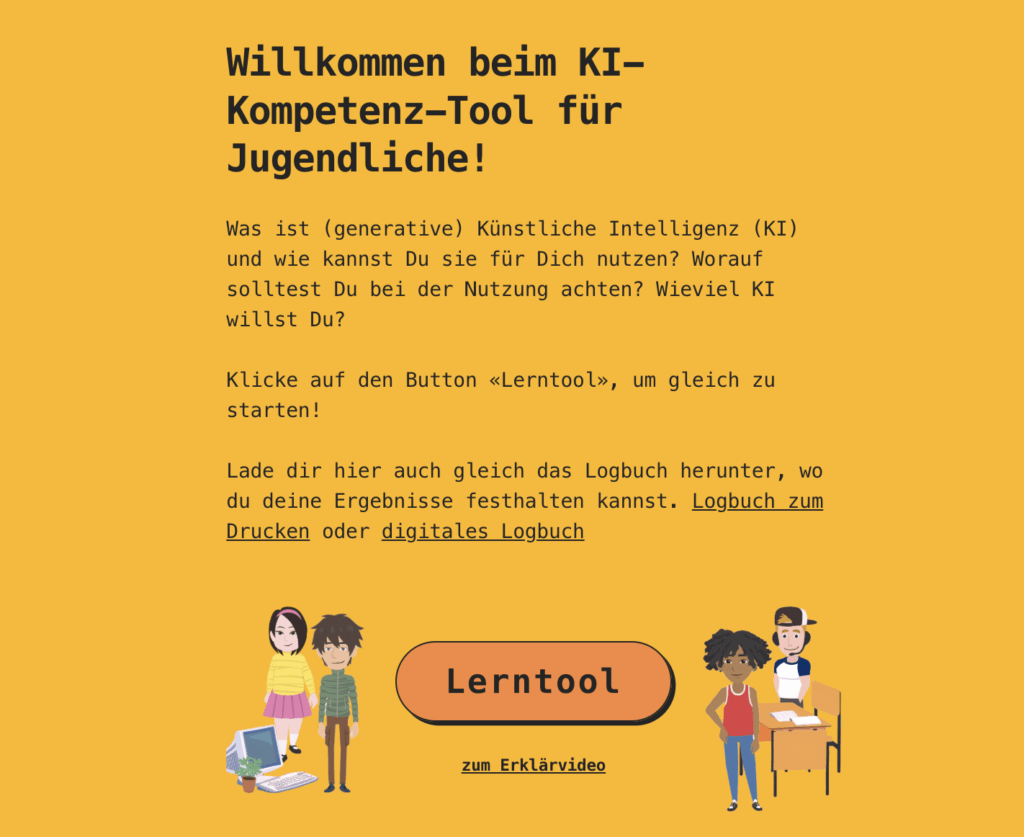
The Next Gen AI School is an interactive learning tool for young people aged between 12 and 16. Its aim is to promote skills in dealing with artificial intelligence (AI) and thus digital resilience. Digital resilience describes the ability to act confidently, reflectively and critically in the digital space – especially in view of the complex challenges associated with generative AI. The tool combines playful elements, storytelling, source criticism and science communication to explore AI in an understandable and critical way.
The tool is designed for use in the classroom, but can also be used independently by pupils or learners. It contains various inputs in the form of videos, podcasts or written explanations, as well as a wide range of tasks. These cover different aspects of AI: the basics of AI, deepfakes, AI-generated disinformation, prompting, source criticism, data protection and ethical issues.
Structure of the tool and use in the classroom
The tool has a modular structure. This means that it can be used either as a whole or in individual parts. Three different ideas have been developed for use in the classroom: for history lessons, media and IT, and as project-based teaching. Individual parts of the tool can be covered in approximately one double lesson.
A brochure has been compiled to accompany the tool for teachers. It also contains an overview of the skills taught in relation to Curriculum 21, such as decoding, reflecting on and using media and media contributions, and critically analysing sources.
Further information
On the website, you will find access to the tool as well as answers to the most important questions and a collection of further materials on the topic, such as additional teaching materials on AI or on increasing media literacy.

Team
Dr. Sabrina Heike Kessler, UZH Institut für Kommunikationswissenschaft und Medienforschung
Dr. Alexandra K. Krebs, PHZH Zentrum Bildung und digitaler Wandel
Valery Wyss, ZHAW Angewandte Linguistik, Institut für Angewandte Medienwissenschaft
Johanna Alves Villalva Zweifel, PHZH Zentrum Bildung und digitaler Wandel
Miriam Eickhoff, ZHAW Angewandte Linguistik, Institut für Angewandte Medienwissenschaft
Svenja Landolt, UZH Institut für Kommunikationswissenschaft und Medienforschung
Ellen Saaro, UZH Institut für Kommunikationswissenschaft und Medienforschung
Practice partner
Running time: 2024-2025
Funding in the 3rd Rapid Action Call “Digital resilience: between deep fake and cyber creativity“