Project state
closed
Project start
June 2023
Funding duration
24 months
Universities involved
UZH, PHZH
Practice partner
Volksschulamt Zürich
In the digital transformation, there is a danger that disciplines will be forgotten. The team is pursuing the question of how a trading zone can be created in which actors from the disciplines of anthropology and computer science meet and work on joint, transdisciplinary products, including teaching units and further training courses.
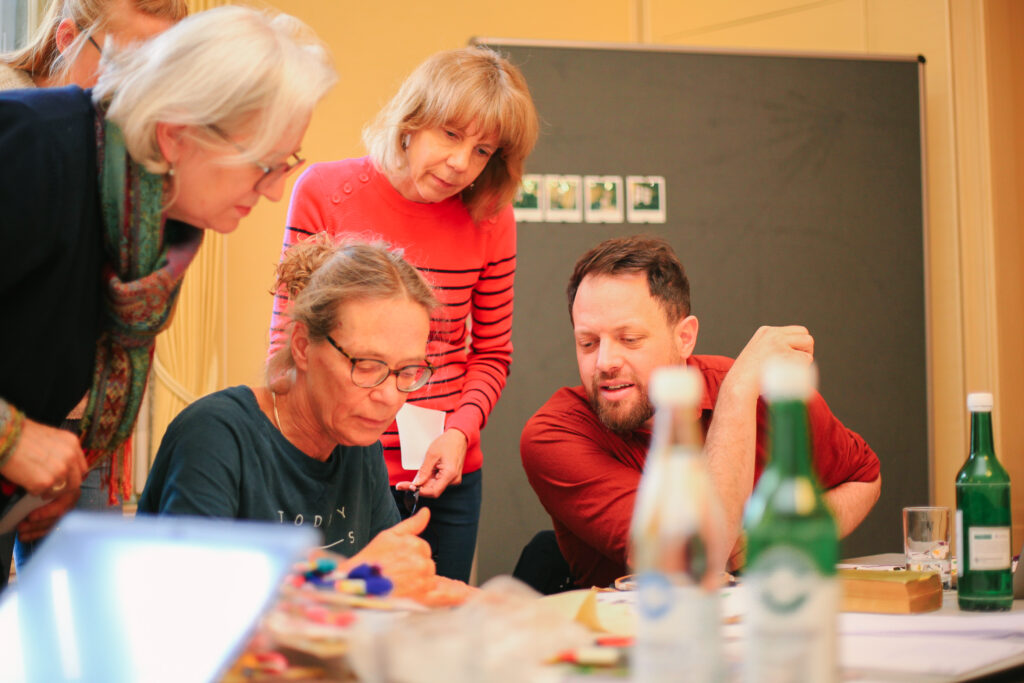
The project focused on exploring a connection between the disciplines of ethnology and computer science, which were initially assumed to be distinct. To this end, an interdisciplinary team comprising programmers, hand embroiderers and researchers from UZH and PHZH met for internal workshops. Their primary aim was to develop a mutual understanding of the perspectives within each discipline. In the process, some were actively introduced to hand embroidery, whilst others were introduced to programming. Through an ongoing process of negotiation, a shared vocabulary was developed that enabled the similarities and differences to be articulated. Weekly “Check-ins” served to document the progress and shared understanding. This resulted in a ‘curve of understanding’ spanning the entire duration of the project. This is available interactively on the website sticken-programmieren.ch, but was also realised as hand embroidery. In collaborative, and at times competitive, embroidery projects in which hand and machine embroidery merged, the advantages and disadvantages of the two embroidery modes were revealed. It became apparent that the grid underlies both embroidery modes and is relevant in their respective interpretations within both disciplines. The project was contrasted with non-grid-based embroidery (example: embroidery by Bedouins) to deepen the understanding of the grid and how it functions.
The project developed an approach to enable disciplines whose connection to digital technology is not immediately apparent to contribute to the ongoing digital transformation process. Whilst in computer science and programming the focus is often on the product, in ethnology and hand embroidery it is on the creation, the process and manual skill. By involving school classes and developing teaching formats, the results can be incorporated into society both as prototypes and in a tangible form. Furthermore, the project developed a format for transdisciplinary collaboration driven and guided by efficient internal and external communication.

Core team:
Prof. Dr. Thomas Schmalfeldt, PHZH Forschung und Entwicklung
Prof. Dr. em. Mareile Flitsch, UZH Völkerkundemuseum
Martina Wernsdörfer, UZH Völkerkundemuseum
Contributors:
Melissa Caflisch, UZH Völkerkundemuseum
Adrian Degonda, PHZH Medienbildung und Informatik
Larissa Meyer, PHZH Medienbildung und Informatik
Christina Serra, freie Mitarbeiterin
Lorena Strohner, Projektmitarbeiterin PHZH
Dr. Martina Wernsdörfer, UZH Völkerkundemuseum
Ina von Woyski, UZH Völkerkundemuseum
Practice partner:
Volksschulamt des Kantons Zürich
Völkerkundemuseum der Universität Zürich
Call type: 2. Project Call