
Project state
closed
Project start
September 2024
Funding duration
12 months
Universities involved
UZH, ZHAW, PHZH
Practice partners
CheckNews
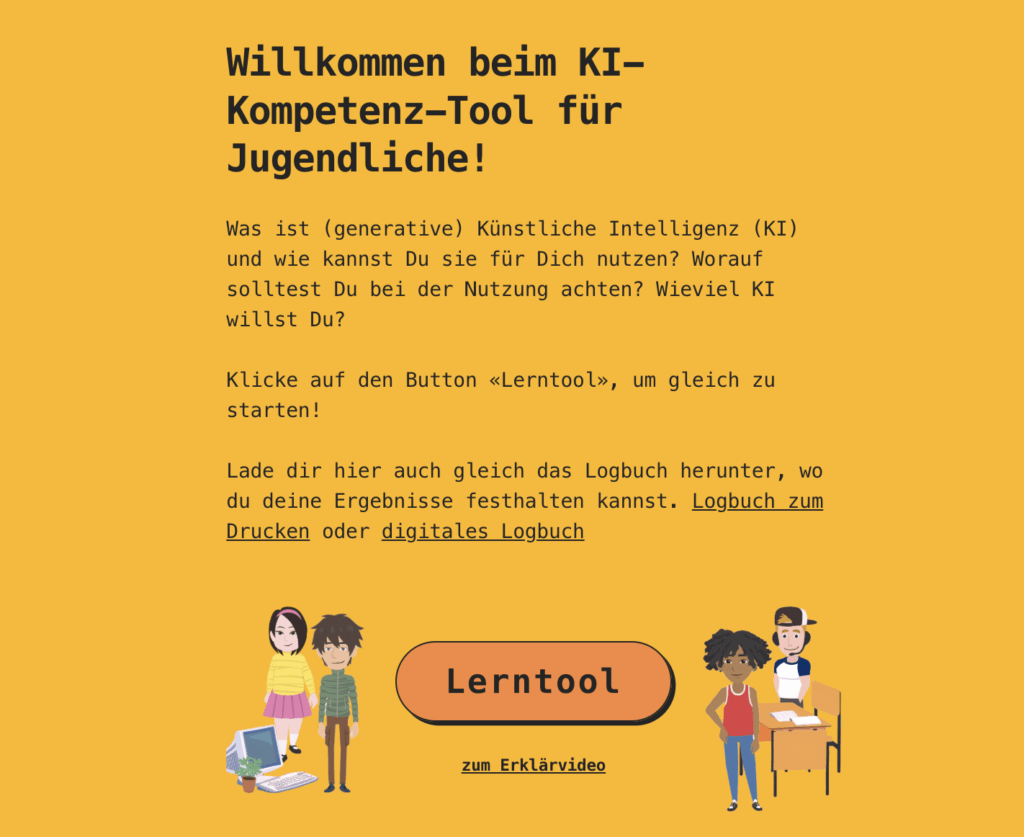
Children and young people no longer use Google; instead, they ask ChatGPT. They know that not every answer is correct, but they often lack the skills to critically evaluate AI content. This is precisely where the project “Digital Resilience: Tool for AI and Deepfake Skills among Young People” comes in. The online tool invites young people on a virtual journey through a school of the future: in interactive stories, they make decisions, explore different rooms and, in the process, learn in a playful way how artificial intelligence works and how to question it critically.
At the NextGenAI School, young people explore the following topics in a practical and accessible way:
- The basics of artificial intelligence: What is (generative) AI? How do algorithms and machine learning work?
- Large language models: How do systems like ChatGPT work?
- Generative AI: What are its possibilities and limitations?
- Deepfakes: How can you spot manipulated content? How do you practise critical evaluation of sources?
- Application in the classroom: How can AI be used effectively in a learning context?
- Ethical questions: Will we still need teachers in the future? How much AI should schools use?
The teaching approach is based on openness and self-direction: learners move freely around the environment, make their own decisions and reflect on different perspectives. Rather than providing ready-made answers, the NextGenAI School encourages discussions about the opportunities, risks and role of AI in education. Trials with young people have met with a positive response. The freedom to move around the learning environment and make their own decisions is particularly appreciated. The setting encourages reflection: Would I like to be in a school like this? How much AI would I like in my everyday school life? The tool also offers a comprehensive collection of resources for teachers and pupils.

Team
Dr. Sabrina Heike Kessler, UZH Institut für Kommunikationswissenschaft und Medienforschung
Dr. Alexandra K. Krebs, PHZH Zentrum Bildung und digitaler Wandel
Valery Wyss, ZHAW Angewandte Linguistik, Institut für Angewandte Medienwissenschaft
Johanna Alves Villalva Zweifel, PHZH Zentrum Bildung und digitaler Wandel
Miriam Eickhoff, ZHAW Angewandte Linguistik, Institut für Angewandte Medienwissenschaft
Svenja Landolt, UZH Institut für Kommunikationswissenschaft und Medienforschung
Ellen Saaro, UZH Institut für Kommunikationswissenschaft und Medienforschung
Practice partner
Call type: 3. Rapid Action Call “Digital resilience: between deep fake and cyber creativity“