Home » Film screening and panel discussion «Humans in the Loop»
Film screening and panel discussion “Humans in the Loop”
Behind every AI is human labour. But who does this work usually remains hidden. The film “Humans in the Loop” tells one of these stories: that of Nehma (Sonal Madhushankar), a single mother from Jharkhand who annotates data so that algorithms can learn to “see”. The footage from the Data Labelling Centre contrasts with the images of Jharkhand’s natural landscape. Director Aranya Sahay, who based his film on Karishma Mehrotra’s investigative report «Human Touch» (2022) as well as his own field research in the region, describes this work as a form of parenting: those who teach AI to see the world shape its worldview.
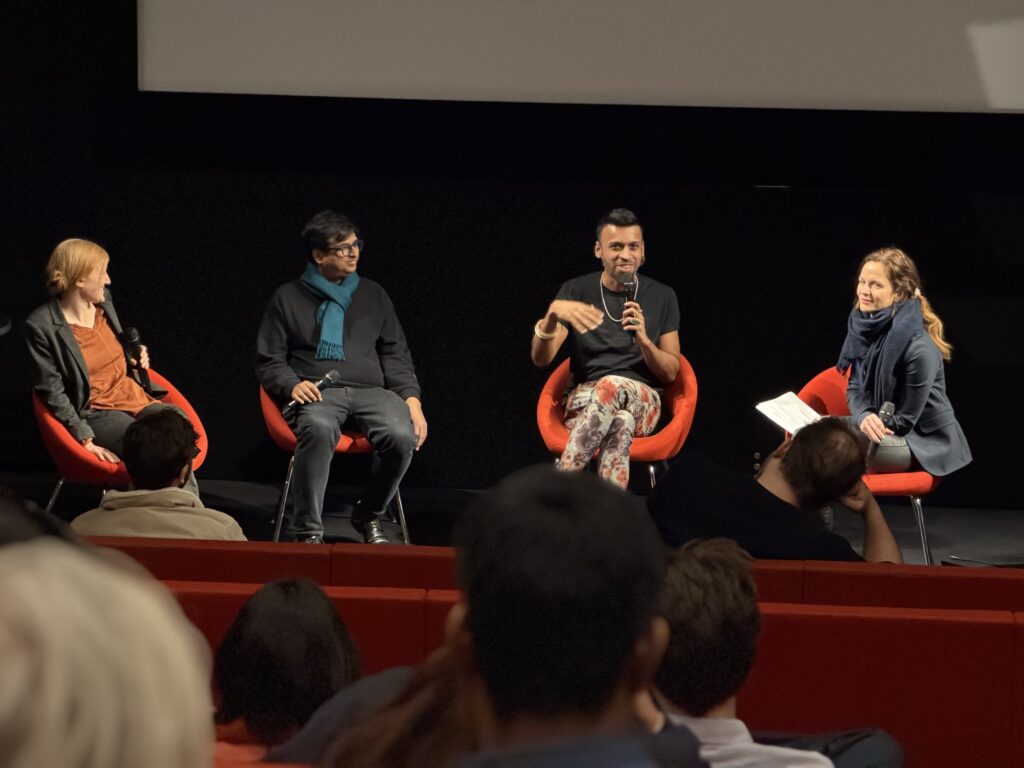
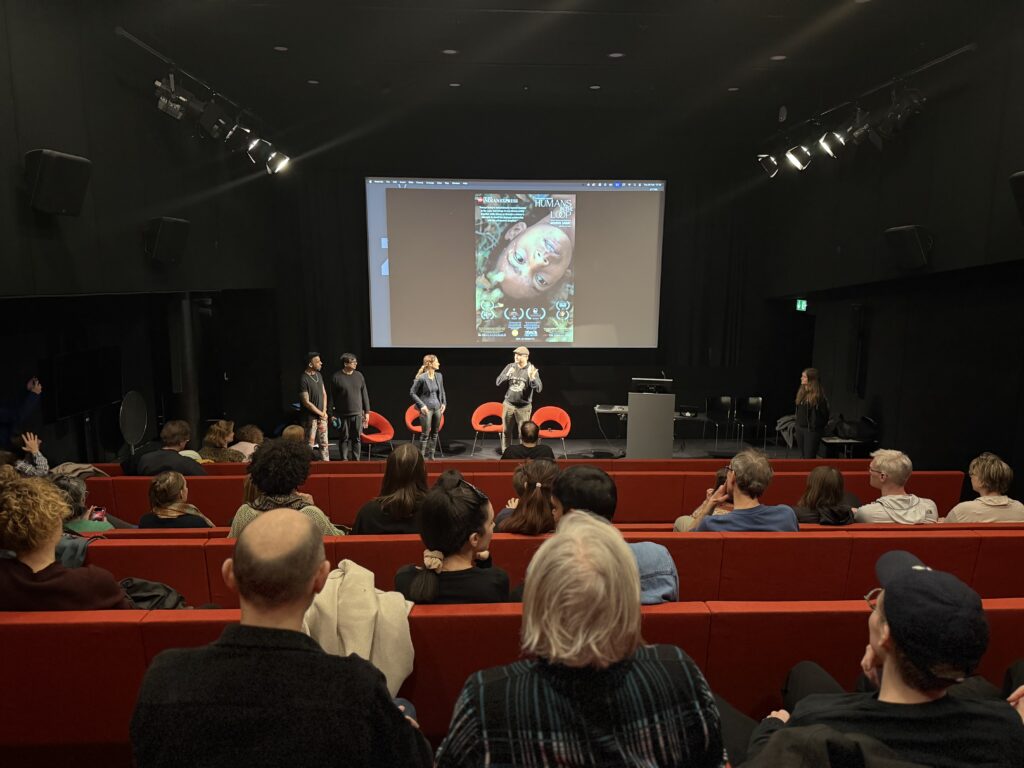
On February 26, we together with ZHAW digital and ZHdK Institute for the Performing Arts and Film we hosted an event at Kino Toni. The screening was followed by a discussion between producer Mathivanan Rajendran, anthropologist Rahul Srivastava (Urbz), and geographer Karin Schwiter (University of Zurich / DIZH Public Data Lab), moderated by Rebecca Brauchli (ZHAW digital).
f.l.t.r.: Karin Schwiter, Rahul Srivastava, Mathivanan Rajendran and Rebecca Brauchli. Photo: Johanna Seiwald
In India, around one million people are employed in data annotation, many of them women with few opportunities on the labour market. The panel discussion made it clear that this reality is complex: the work is repetitive, often poorly paid, and exploitative. At the same time, it can open up opportunities, especially in rural regions such as Jharkhand.
Rahul Srivastava emphasized that inequality does not only arise locally. Technology reinforces existing global imbalances, and AI systems predominantly reflect the perspectives of the Global North in many areas. Those who provide the data do not determine what is built with it or who benefits from it. According to Karin Schwiter, the film helps us to see data workers not just as laborers, but as people with hopes and dreams. Mathivanan Rajendran sees universities as important places for negotiating what a more equitable technological future could look like. Demystifying AI and understanding that there is a human being behind every click is a necessary first step in this process.
Special thanks to Navina Gupta (ZHAW digital) for her initiative, Manuel Hendry and Miriam Lörtscher (ZHdK Institute for the Performing Arts and Film) for their support, the panel participants, and everyone who watched the film with us.
f.l.t.r.: Rahul Srivastava, Rahul Srivastava, Rebecca Brauchli and Manuel Hendry. Photo: Johanna Seiwald